How Should Brands Plan a Staged Baby Monitor Firmware Rollout?
Plan a staged baby monitor firmware rollout with eligibility, stop conditions, recovery ownership, and controlled expansion for approved configurations only.
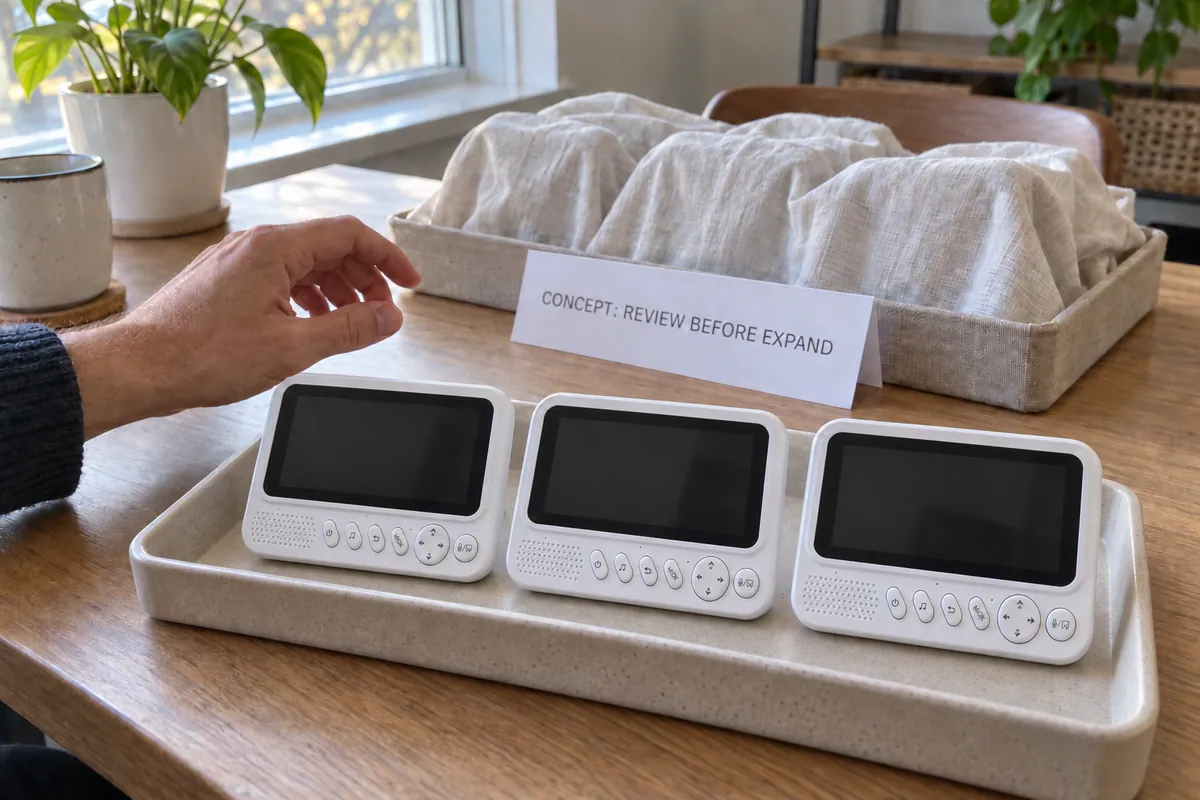
An approved firmware change is not the same thing as a completed rollout. Approval answers whether a defined version may be used for a defined configuration. Rollout answers who receives it first, what the team watches, who can stop it, how affected users are supported, and how the next group is released. Treating those as one decision creates a dangerous gap: a team can have a technically approved build but no controlled way to learn from the first deployment.
This article starts after the change has been approved through the applicable review route. It does not approve a component, alter hardware, or assume an ANHONG product supports over-the-air updates. It offers a staged-deployment planning tool where the selected route can perform the agreed update process.
Why Does Change Approval Not Authorize Every Deployment Step?
Change approval should identify the configuration, version, reviewed scope, evidence, decision owner, and conditions. It answers: “May this defined change proceed under these conditions?” A rollout plan answers different questions: “Which eligible units receive it first? What pauses expansion? Who tells support?”
Keep the records linked but separate. An approval record might say that a build is accepted for a named configuration. It should not silently become permission to deploy to every private-label variant, hardware revision, market, or channel.
NIST's patch-management guidance includes identifying, prioritizing, acquiring, installing and verifying updates. That supports the narrow point that verification belongs in the update process. It does not prescribe a rollout size, recovery method or update technology for a baby monitor.
What Is a Staged Firmware Rollout Card?
Use the following card after an approved version exists. It is a proposed operational record, not a claim that any particular model has OTA, app-mediated, local-service, or other update capability.
| Card field | Decision or evidence to record |
|---|---|
| Approved baseline | Product model, configuration, old version, approved target version, and approval reference |
| Eligibility boundary | Which owned units, channel group, or service cohort may be considered, and which must be excluded |
| First release group | The limited, explicitly authorized group and its responsible owner—not an invented percentage |
| Observation plan | Expected signals, review window, collection owner, and limitations of the available evidence |
| Stop conditions | Specific findings that pause the next group and the person authorized to stop expansion |
| Recovery route | Customer-facing next step, technical triage owner, and whether a supported recovery method is confirmed |
| Expansion decision | Review record showing why the next group may proceed, pause, or be revised |
| Communication record | Approved support and channel wording, affected configuration, and contact route |
Do not copy a percentage from another program; the right boundary depends on configuration, delivery mechanism, evidence, buyer relationship, and acceptable disruption.
How Should a Brand Define a Meaningful First Release Group?
Begin with eligibility, not volume. Identify the exact version path, hardware/configuration identity, market, account or distribution route if relevant, and any population that must not be touched. A unit outside the approved baseline is not a valid member of the first group merely because its product name looks similar.
Then ask what the first group is expected to reveal: the update journey, customer instructions, post-update pairing behavior, or a defined feature path. State those as observation questions, not expected success claims.
ANHONG’s verified service boundary includes firmware, App/UI, samples, quality testing, product definition, manufacturing, and B2B after-sales coordination. In an OEM or ODM discussion, a buyer can supply the approved baseline, candidate group, required observations, support constraints, and desired decision record. ANHONG can help scope the project interface. That does not establish a release platform, rollout telemetry, signing arrangement, recovery path, or fleet-management function for a particular product.
Which Findings Should Pause the Next Group?
Write stop conditions before the first release. They may include an update that cannot be completed through the approved path, a newly observed loss of an agreed function, a customer instruction that repeatedly causes an unsupported outcome, an unexpected configuration mismatch, or evidence the group was not eligible. Each condition needs an owner, a pause action, and a record of what must be understood before another expansion decision.

Avoid calling every support contact a deployment failure, and do not dismiss every report as user error. Capture configuration, version, pathway, time context, and available evidence; then compare it with the approved baseline. A pause prevents a weak signal from turning into an uncontrolled wider release—not to prove root cause immediately.
The quality-control and testing discussion can help frame the evidence conversation, while the actual test scope must remain tied to the specific change and configuration. A staging card cannot replace an approved change record, a technical investigation, or market-specific review.
How Should Recovery Be Described Without Overpromising?
Separate a known recovery route from a hoped-for one. If the offered configuration has a confirmed recovery procedure, record conditions, owner, and customer instructions. If it does not, record the escalation route. Never put “rollback” in public copy merely because the team wants one.
Support needs a version-aware script: affected configuration, expected customer observation, appropriate information, stop point, and escalation. The brand owns its customer promise; technical owners document the route and limits.

How Should Expansion Decisions Be Recorded?
At each gate, preserve the target version, eligible group, observations, unresolved items, stop-condition status, support contacts, and decision owner. The decision can be expand, hold, revise, or end. “No major issue seen” does not state what was observed.
This chain is useful for private-label variants. A decision for one brand, language pack, accessory set, or configuration should not silently authorize another. For a discussion about version scope, see ANHONG’s baby monitor customization page and product-development support.
How Should Customer and Channel Messages Fit the Rollout?
Prepare messages only for the chosen plan. A customer message should name the relevant product/configuration, action if any, available support route, and known limitation. A channel message should say whether the item is affected and who owns follow-up. Do not promise a universal update date, an uninterrupted process, restored service, or an improvement that has not been verified for the recipient’s configuration.
Before the next group expands, compare the proposed message with the card. If the card names an unresolved recovery path, the public copy cannot pretend it is resolved. That small check protects the launch promise as much as the technical staging does.
What Do Buyers Commonly Ask About Staged Firmware Rollouts?
Is a signed-off firmware build ready for every device?
No. Approval must be read with its configuration and conditions. A staged rollout separately defines eligible units and expansion decisions.
Does staged rollout mean that an update can be reversed?
No. A staged approach limits expansion while observations are reviewed. A recovery or reversal path must be confirmed separately for the offered configuration.
Should the first group be a fixed percentage?
Not by default. Select a bounded group based on the observation question, eligibility, evidence, and support capacity; record why it was chosen.
What should a brand provide to start the planning discussion?
Provide the approved change record, target product configuration, intended update route, candidate population, observation questions, and support constraints. Contact ANHONG to turn those inputs into a scoped firmware and project discussion.