How Should Buyers Evaluate PTZ Position Repeatability and Reframing Effort?
Evaluate PTZ baby monitor reframing through target views, correction counts and repeatable sample exercises without assuming presets or tracking.
Buyers should evaluate PTZ position repeatability by asking a simple operational question: after an operator moves a supported PTZ camera away from a useful view, how consistently can that view be found again, and how much correction is needed? The answer should come from a recorded sample exercise, not from a promise that a camera will always stop in the same place.
That distinction matters because a PTZ camera is purchased for a viewing task, not for the fact that it can move. A family may need to return to the crib area after checking a doorway; a support team may need to explain a repeatable set of steps; a brand may need to decide whether the offered control method fits its product position. None of those questions requires assuming that a model has presets, automatic tracking, or a stated positional accuracy.
ANHONG supplies PTZ cameras alongside non-WiFi, WiFi, hybrid, audio, and other baby-monitor products. For a configuration confirmed to support PTZ movement, our product-definition, hardware, firmware, and App/UI capabilities can help a buyer turn a broad request such as “easy reframing” into a sample-review task with defined evidence.
Why Is Repeatability More Useful Than a Generic PTZ Demonstration?
A smooth demonstration proves little if the operator never tries to return to a useful view. A repeatability exercise checks the practical loop: identify a target, move away, return, and decide whether the framing is usable without further adjustment.
The buyer is not trying to certify a universal accuracy number. The buyer is deciding whether the reviewed product and control path support an agreed viewing routine. For one project, a useful result may mean that the selected sleeping area is back in frame. For another, it may mean that a caregiver can re-establish an agreed room view without trial-and-error. Define the target before starting; otherwise, “close enough” will be interpreted differently by each reviewer.
This focus also keeps the article separate from a control-usability review. A button can be clear while the effort needed to return to a chosen view is still high. Conversely, a reviewer can make a target view repeatable after learning the route even when the first-time controls need clearer labels. Both questions deserve their own sample evidence.
What Should a Reframing Exercise Record?
Record the route and the outcome, not only the final opinion. A compact worksheet makes reviews comparable across reviewers and samples.
| Run | Starting view | Target view | Control route used | Stop point | Corrections after return | Usable framing? | Observation |
|---|---|---|---|---|---|---|---|
| 1 | Doorway area | Chosen crib zone | Defined by reviewer | Describe where movement stopped | Count deliberate corrections | Yes / no / needs agreement | What made the result clear or difficult |
| 2 | Window-side area | Chosen crib zone | Same or alternate route | Describe where movement stopped | Count deliberate corrections | Yes / no / needs agreement | Note any difference from Run 1 |
The table is an illustrative buyer tool, not an ANHONG test record. It should identify the hardware and software version, camera placement, control method, reviewer, and date. If a comparison uses a parent unit and an app route, record them separately only when the selected configuration actually offers both. Do not collapse two different workflows into one score.
The most useful measurement is often the correction count combined with a short observation. One correction may be acceptable in a large room but frustrating for a repeated monitoring task. The count gives the discussion a shared starting point; the defined target and reviewer comments explain why it matters.
How Should a Buyer Define a Target View?
Define a visible area rather than an imagined angle. The target might be “the mattress area and the near-side floor boundary” or “the central play area between two fixed room features.” It should be broad enough to reflect real viewing use, but specific enough that two people can judge it consistently.
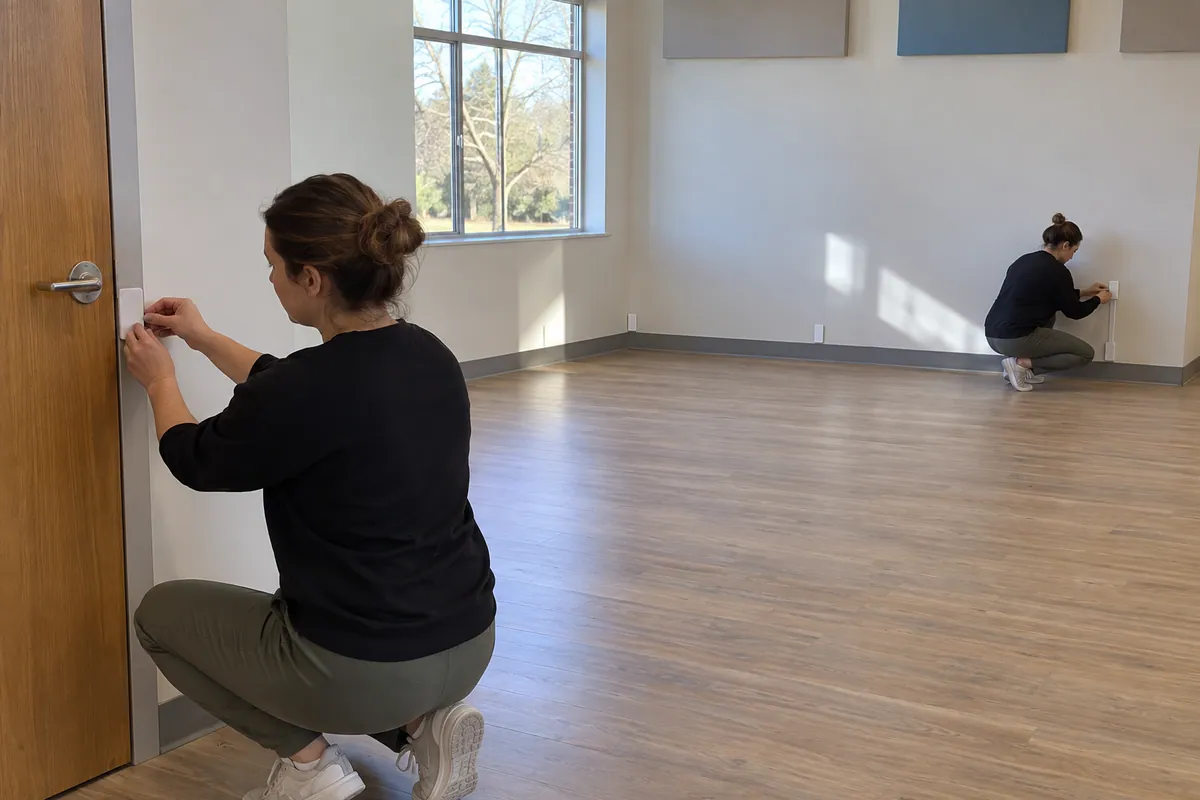
Use room features that will remain in place during the exercise, such as door edges, wall corners, or furniture boundaries. Avoid attaching meaning to a child, a face, or a moving object. The exercise assesses reframing effort, not detection performance, clinical monitoring, or the camera’s ability to follow activity.
At ANHONG, samples can be part of OEM and ODM discussions. We would recommend agreeing the target-view definition before the sample meeting, because it connects the buyer’s product intent to the actual physical room setup and available control path. It also reveals whether a buyer needs an alternate camera position, a different configuration, or clearer product instructions before committing to a sales message. See our baby monitor product-development overview for the broader project scope.
When Does a Correction Count as a Correction?
Count a deliberate movement made after the reviewer believes the target has been reached. Small continuous motion while approaching the target can be treated as part of the initial route if the rule is agreed before the exercise. A stop, visual check, and further movement is a correction.
This rule prevents a review from rewarding an operator who quietly makes several extra adjustments. It also avoids over-interpreting natural variation in hand or button operation. The objective is not to produce a laboratory precision figure; it is to show how much active reframing a typical approved route requires.
Ask each reviewer to note the reason for a correction: target partly outside the view, too much empty room, uncertain stop point, unclear on-screen context, or another observed reason. Those notes can guide product definition more effectively than a single pass/fail mark.
How Should Buyers Compare Different Control Routes?
Compare routes only when the product actually supports them. A physical controller, a parent unit, and an app may each create a different sequence, feedback pattern, and reframing effort. State which route was used, then repeat the same starting view and target view.
Do not treat one route as a failure merely because it takes more steps. A brand may intentionally reserve some controls for a particular interface. The practical question is whether the selected route is understandable for the intended user and commercial promise. If the brand plans to present remote reframing as a key benefit, it should evaluate that route in the relevant reviewed configuration rather than infer it from a local demonstration.
ANHONG’s App/UI and firmware work is relevant when a buyer needs to discuss the interaction path alongside the camera hardware. We can help scope the request, while the buyer decides which supported functions belong in the final product brief and which claims are appropriate for the selected model.
What Should Change After an Unclear Reframing Result?
First decide whether the issue is the target definition, the room placement, the control path, or the selected configuration. A vague target cannot be fixed by adding more buttons. A difficult room view may call for a different physical placement. An unclear route may need a revised interaction or clearer instructions. A missing function should remain a development question until it is demonstrated and approved.
Record the proposed next step in the sample-release file: repeat with a revised target, assess another confirmed control route, request a design discussion, or defer the feature from launch wording. This creates a cleaner bridge between sample work, packaging localization, user materials, and later mass-production planning.
For a PTZ baby monitor project, contact ANHONG with the intended room use, target market, and the confirmed configuration you want to evaluate. We can discuss samples, product definition, and the OEM or ODM scope needed to make the review useful.
What Do Buyers Ask About PTZ Reframing?
How should different operator experience levels be recorded?
Identify whether each run is a first-use observation or follows an agreed familiarization step, and record the reviewer category. Do not average the two into one score: they answer different product and instruction questions.
Can results from different firmware versions be combined?
No. Retain the available firmware and hardware identity with every run. A later configuration may be reviewed beside an earlier one, but its observations should remain separately labeled.
What should a buyer do when the first run differs from later runs?
Keep both results. The first run can expose discoverability or instruction issues; later runs can show the effort after the route is understood. Agree which outcome is relevant to the intended product claim.
Does this exercise confirm a preset or tracking feature?
No. It concerns operator-led return to a defined view. Any preset, tracking, detection, or other automated function needs separate confirmation for the selected configuration.


