How Should a Baby Monitor Explain the Difference Between Live and Stale Video?
Learn to distinguish live, delayed, stale, and unavailable baby monitor video states, then align listing language with sample-review evidence.
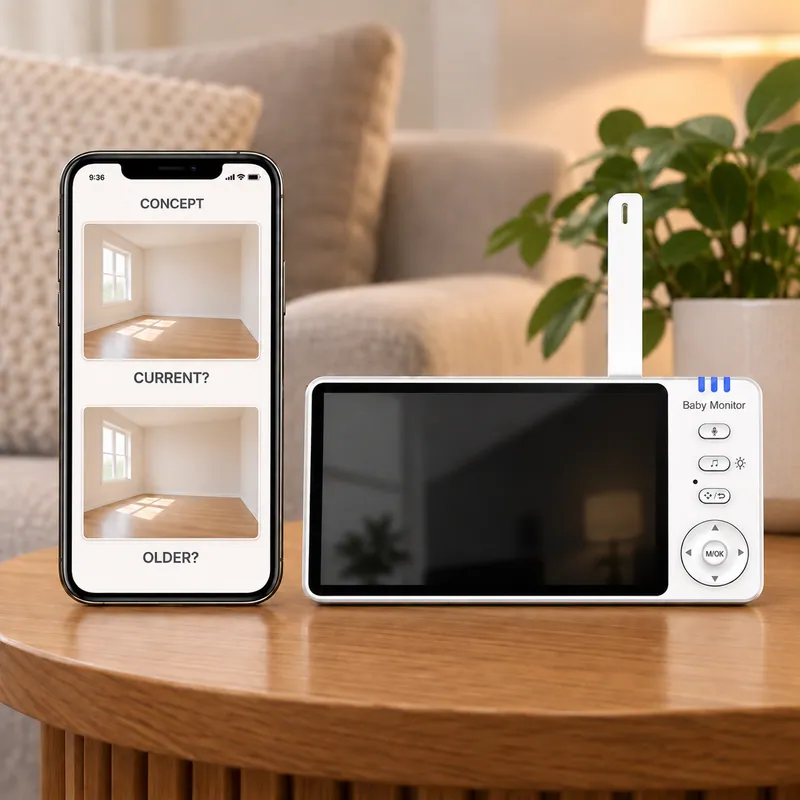
“Live” should describe the current viewing state, not merely the presence of a picture. A picture may remain visible when a player has stopped receiving new data or an app retains the last decoded frame. Those conditions are not automatically a delay problem. The buyer's question is whether the interface distinguishes a progressing view, an earlier image and an unavailable feed.
Define the states, customer-facing wording, and proof expected for each state before packaging, help content, or a listing uses “live view.”
Why Is a Frozen Picture Not Just a Slow Picture?
Delay is the gap between an event and a newly displayed view. A stale picture is different: the display can look stable while no newer picture is arriving. A third condition is a genuinely live feed, where new video continues to reach the viewing endpoint. A fourth is unavailable, where the product cannot offer a view at all.
The interface should not use the same reassuring label for all four. A clock, “last updated” indication, reconnecting state, or clear unavailable state may be relevant, but behavior must be agreed for the selected product. A timestamp alone does not prove end-to-end freshness.
The W3C WebRTC statistics specification includes timestamps and inbound video statistics. For a system using that technology, relevant observations can help investigate whether frames are progressing. This is an engineering example, not proof of end-to-end freshness or a claim that any ANHONG baby monitor uses WebRTC or exposes those fields.
What Should the Product Promise Actually Say?
Start by separating a marketing phrase from an observable product state. “View your baby live” is too broad until the team answers: live from which device, at which endpoint, under what connection condition, and with what warning when that condition changes?
| State to define | What the viewer may see | What the product wording should make clear | Evidence to request before approval |
|---|---|---|---|
| Live | Newly progressing video | The view is currently receiving new content under the defined condition | Recorded scenario, build/configuration ID, and observation method |
| Delayed but progressing | New content continues after a measurable gap | The view is progressing; the delay measure and threshold require a separate definition | Event-to-display method and result record |
| Stale | The last image remains but new content is not confirmed | The image may not represent the current room; show the agreed warning or transition | Network-loss or source-stop scenario and the observed UI state |
| Unavailable | No usable current view | A connection or source is unavailable; state the next user action if one exists | Recovery, retry, and support-path observations |
This Freshness and Actionability Table is a proposed requirement tool, not a claim about ANHONG’s current app behavior. Its value is that it prevents a brand from approving a polished normal-path demo while leaving the misleading edge case unnamed.
How Should a Team Decide When Video Has Become Stale?
First, name the observation point. The camera may still be capturing while an app has stopped receiving. The app may receive data while a displayed frame is no longer advancing. A brand should not collapse these into one sentence such as “the connection is good.”
Then write a testable rule in product language. For example: “When the selected client cannot confirm new video according to the approved rule, it must leave the live state and show the agreed customer message.” Leave the precise timer, transport measurement, and fallback behavior open until they are confirmed for the model, configuration, and platform. A made-up number would create a promise nobody has validated.
Finally, test transitions, not just a steady feed. Review startup, ordinary viewing, temporary network interruption, relevant source interruption, reconnection, and app foreground/background behavior where applicable. Record the viewer-visible state and the help-content wording. Repeated measurements can be compared over time; that is a useful engineering pattern, not a required architecture.
Who Should Own the Message When the Feed Changes State?
The brand owns the user promise: approved labels, what a parent should do next, and which channels may use “live.” The technical team owns the documented state logic and the evidence that the selected configuration behaves as described. Support owns the recovery wording and escalation path. The reviewer owns the recorded test result and its limits.
ANHONG can contribute at the handoff points that are within our confirmed services: product definition, firmware, App/UI, samples, quality testing, and B2B after-sales coordination. A buyer can bring the required states, target market, intended sales copy, and sample-review scenarios; ANHONG can help scope the configuration discussion and the evidence request. That is not a promise that every WiFi, non-WiFi, or hybrid platform offers the same state indicator, cloud path, or reconnection behavior. It must be confirmed for the exact product route.
Which Review Records Stop “Live” From Becoming a Vague Claim?
Keep one compact record for each approval: product model and configuration; camera/parent-unit or app endpoint; build/version where applicable; defined state; trigger scenario; viewer-visible wording; observed result; unresolved question; decision owner; and the approved listing phrase. Link it to the product-development discussion and the sample, MOQ, and lead-time planning page only as context for the project route, not as proof of a feature.
This record also keeps a future software change honest. If a UI message, reconnection rule, or video path changes, the team can identify the old promise and rerun only the affected scenarios. It should not be replaced by an assumption that a firmware build or app release preserves every customer-facing behavior.
How Should a Brand Review Listing Copy Before Launch?
Read each “live,” “real-time,” “instant,” or “always connected” phrase next to the table. If the team cannot explain the stale and unavailable transitions, soften or remove the phrase. If a state marker exists, confirm that the listing does not imply more than the marker proves. Avoid presenting a recovery action as a guarantee of restored service.
For Private Label, OEM, or ODM work, ANHONG’s customization process can be the place to align customer-facing language with the selected configuration and review scope. Bring the proposed promise and the state table into that conversation. The useful result is a bounded requirement and approval record—not an unverified assurance about every home network.
What Do Buyers Commonly Ask About Live and Stale Video?
What if the interface shows an advancing clock over a fixed image?
Identify where the clock originates. A client-side display clock could progress independently of the video. The requirement should explain what the indicator actually represents; do not treat any changing number as proof of a newly captured frame.
Should a saved clip use the same presentation as a current view?
If playback is supported, make its state distinguishable through approved wording and controls. Review the transition back to current viewing separately. A recording label should not remain on a live view, or disappear while earlier footage is still playing.
What if two viewers disagree about freshness?
Record each endpoint independently. One endpoint's progressing view does not demonstrate that another endpoint is receiving or displaying new frames. Keep their trigger scenarios, connection paths and observed messages separate in the record.
Can a reviewer use an ordinary still scene to test progression?
Choose an authorized observation method that can distinguish new content from a retained frame. A scene with no visible change may leave that question unresolved. Agree the method with the project team rather than inferring progression from image quality alone.
To define freshness states for an offered configuration, contact ANHONG with the intended viewing endpoints and user messages.