Why Does Your Baby Monitor Buzz at Night, and How Should You Evaluate Noise Reduction?
Compare baby monitor noise reduction by separating hum, hiss and interrupted audio, then check quiet-room playback under clearly recorded sample conditions.
“The picture is fine, but the audio is distracting” is a useful problem statement for a sample review. It is not yet a diagnosis. Before requesting a different chip or a noise-reduction feature, I would ask the buyer to describe the sound: steady hum, soft hiss, intermittent crackling, or a repeating interruption?
Those observations help an engineering team reproduce the issue. Calling all of them “static” can send the investigation toward the wrong part of the product.

Where Can Unwanted Audio Come From?
The path includes the room around the camera, microphone and input electronics, processing, transmission and parent-unit playback. Noise heard at the speaker does not automatically originate in the wireless link.
| Observation | Useful next check |
|---|---|
| Steady hum | Compare supported battery and charging operation and reproduce the power setup. |
| Continuous hiss | Compare gain and volume settings with the same camera-room conditions. |
| Intermittent crackling | Record when it occurs, including link conditions and activity near the devices. |
| Sound repeatedly opens and closes | Check sound activation, mute and processing settings. |
These are investigation paths, not diagnoses. A recording and a repeatable setup are more useful than declaring a unit defective or fault-free from the description alone. Half-duplex describes communication direction; the label itself does not establish the cause of a buzz.
Why Does It Become More Noticeable in a Quiet Room?
A low-level sound can be easier to notice when there is less surrounding household sound. The listening position also changes the experience. That is why a demonstration in a busy showroom cannot replace a quiet-room check.
Keep the listening distance and device position consistent when comparing samples. Do not translate a change in distance into a universal claim about perceived loudness; rooms, speaker direction and the listener all matter.
Start at ordinary listening volume. Note whether the audio is comfortable and clear, then evaluate other settings within the intended use described by the supplier. Do not put a speaker close to an ear at maximum output as a routine test.
What Should Baby Monitor Noise Reduction Actually Mean?
Ask which problem the feature addresses. Background-noise reduction and acoustic echo cancellation are distinct functions. For example, Texas Instruments’ two-way audio reference design describes both noise reduction and echo cancellation in an audio-processing system. That reference explains the distinction; it does not prove that a particular monitor uses the same design or achieves its results.
A marketing label such as “3D noise reduction” is not enough to identify the implemented audio algorithm. Request the audio-specific description and evaluate the result. Likewise, “hardware DSP” or “software processing” alone does not establish which finished product sounds better.
Listen for the trade-off: reducing background sound should not make wanted audio difficult to understand, clip its beginning, or produce distracting changes during quiet passages. Compare a steady background sound and a repeatable wanted sound under the same settings.
What Should a Supplier’s Noise Report Include?
Which configuration produced the result?
Record the model, firmware, power source, microphone settings, parent-unit volume and operating mode. Include whether VOX, mute or other processing was enabled.
How was sound measured?
If the report gives an acoustic noise figure, ask for the measurement position, room background, instrument and measurement method. A decibel value without its conditions is not a complete acceptance specification.
Does the quiet result preserve useful audio?
Repeat playback with a representative sound at the camera. Check intelligibility and activation behavior rather than accepting a quiet speaker that has simply muted the input.
Can the issue be reproduced consistently?
Keep a recording, setup photograph and settings sheet with the sample record. Repeat questionable results before attributing them to the product or the room, and have the supplier investigate under the same conditions.
What Else Do Buyers Ask About Audio Noise?
Does digital transmission mean silent playback?
No. The finished audio path still needs evaluation. A digital-link label does not describe microphone noise, playback gain or the behavior of processing.
Does crackling prove wireless interference?
No. It is an observation to reproduce. Record the conditions and compare controlled changes before deciding where it originates.
Should every sample use the same maximum volume?
Compare the intended listening settings and document any maximum-output check separately. A matching volume number on two products does not establish matching acoustic output.
Can a noise gate hide weak audio engineering?
Muting quiet passages can make idle playback seem silent. Check how it opens and closes and whether wanted audio is lost. Judge the complete behavior, not silence alone.
What should go into the purchase specification?
The agreed configuration, test method and acceptance criteria, plus the process for investigating exceptions. Do not substitute a generic noise-reduction feature name for those details.
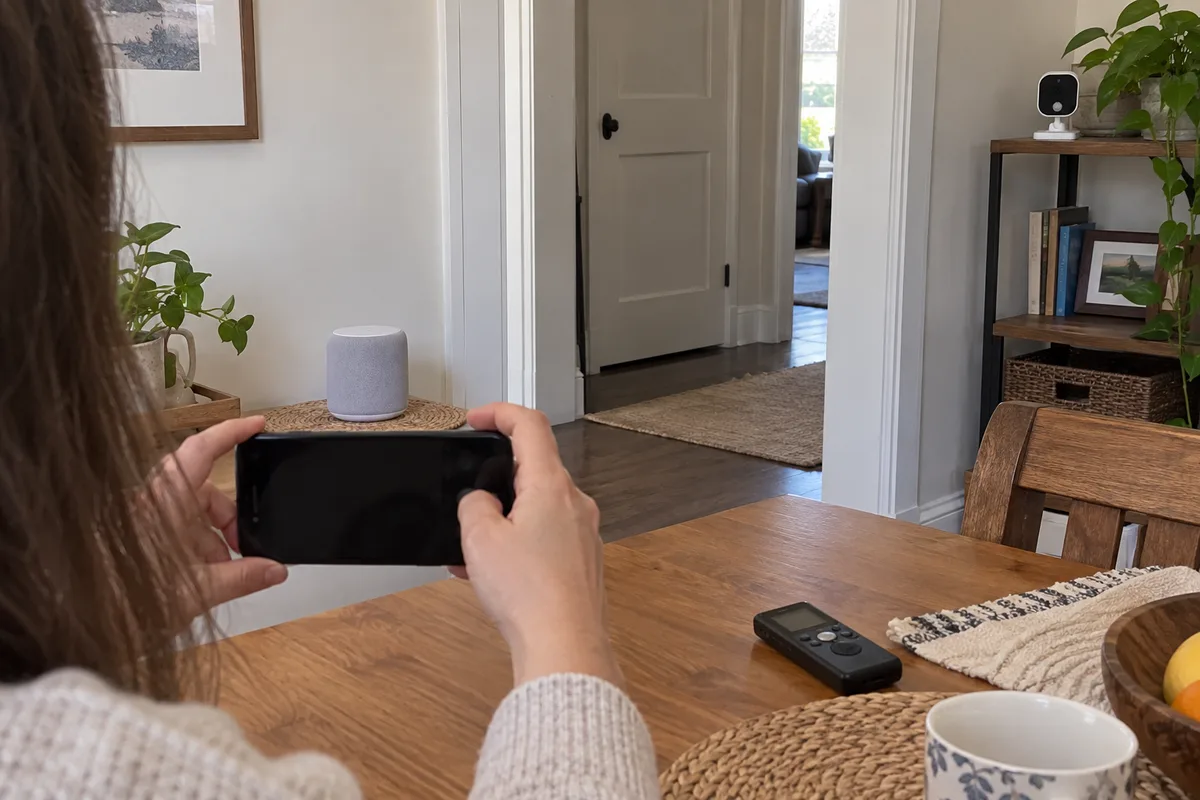
For buyers comparing baby monitor noise reduction, the practical next step is a repeatable sample check. Share the intended audio behavior and evaluation conditions with ANHONG when discussing product definition or OEM/ODM requirements, so the result can be judged against a clear brief.


