What Should Buyers Ask About Audio Behavior When Video Quality Degrades?
Review baby monitor audio separately from video during defined degradation scenarios, with clear state descriptions and limits on what the evidence shows.
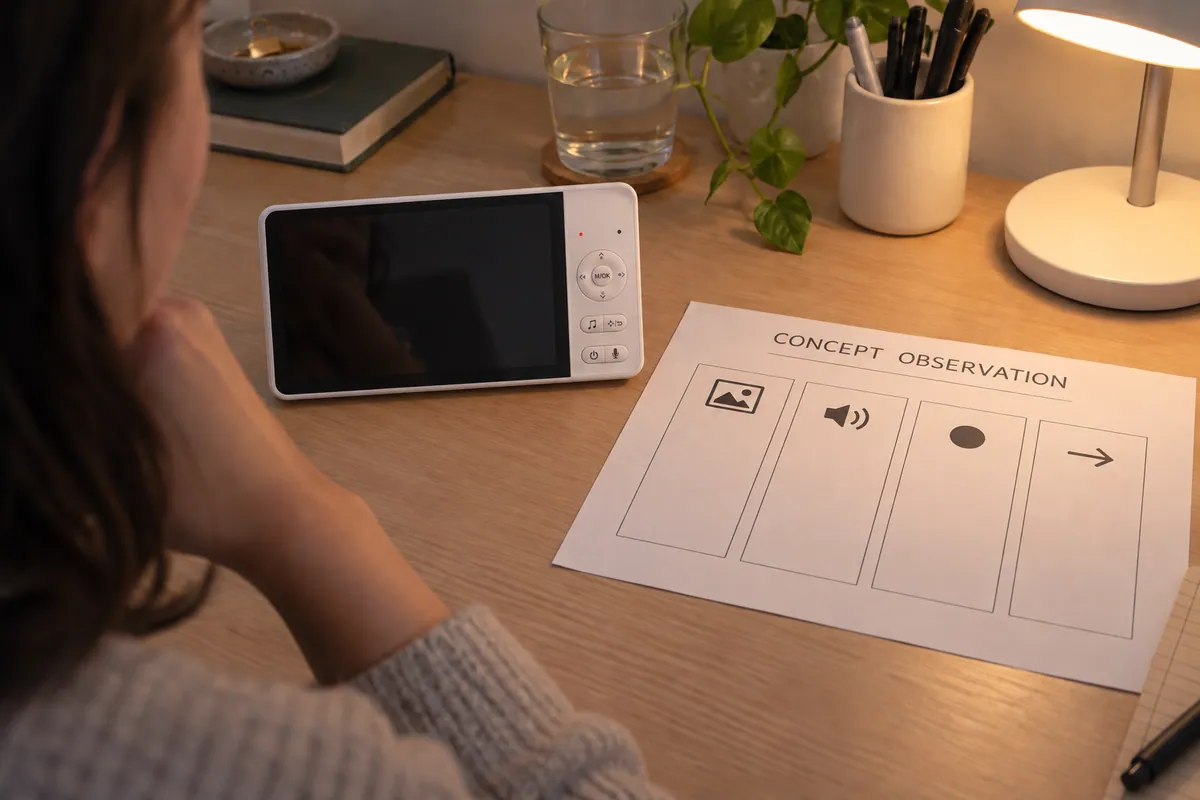
When video becomes blocky, delayed, frozen, or unavailable, a buyer should not assume audio has failed in the same way—or that audio remains usable. Audio and video can take different paths, use different buffers, and produce different user-visible states in a selected configuration. The practical sourcing question is therefore not “does audio have priority?” It is: what does the customer hear and see under the defined degradation scenario, and what does the product tell them to do next?
This is a proposed observation method, not a claim about ANHONG monitor architecture, audio continuity, radio behavior, or a universal alert strategy. It does not repeat a radio-interference or range test. It helps a brand distinguish the evidence needed for an audio/video experience statement.
What Should Be Kept Separate?
Separate video quality from video freshness, audio audibility from audio meaning, and observed behavior from a cause diagnosis. A grainy image can still be advancing. A frozen image can coexist with continued audio. Audio can become interrupted while a view remains visible. One scenario does not prove why the condition happened or predict every network, distance, obstruction, or product configuration.
Define the selected scenario before observation: what is intentionally changed, which camera and parent-unit or app endpoint is used, what normal state is the baseline, and what the reviewer must notice. If the project uses a connected product, do not borrow conclusions from a local-link sample, or the reverse.
How Can an Audio and Video Degradation Task Table Help?
| Observation point | Video question | Audio question | Customer-state question | Record to retain |
|---|---|---|---|---|
| Normal baseline | Is the intended view progressing? | Is the agreed sound source audible? | What labels or indicators are present? | Configuration, build, setup |
| Defined degradation | What changed in clarity, progress, or availability? | Did sound continue, change, or stop? | What does the product say about the state? | Trigger and time context |
| User response | What can the reviewer do next? | Is a separate audio control relevant? | Is recovery wording understandable? | Task observation |
| Recovery | What returns to the intended state? | What audio behavior is then observed? | Does the visible state match? | Final observation and limits |
The Audio and Video Degradation Task Table is a buyer tool. It does not set a required audio priority, guarantee an alert, or prove a result for a product not tested under the stated conditions.
Why Should a Brand Avoid the Phrase “Audio Still Works”?
That phrase hides the important questions. Is the reviewer hearing current sound, intermittent sound, delayed sound, an alert, playback, or a stored fragment? Is the app or parent unit showing a connection message? Can the user tell that the video condition has changed? A brand needs an approved wording boundary before it turns one favorable observation into a channel claim.
Ask the reviewer to describe the sound source and the user task. For example, they may need to distinguish ordinary room sound from a system notification, or to identify whether muting and volume settings alter the observation. Never imply that audible sound is a safety guarantee or that it compensates for an unavailable view.
ANHONG can connect product definition, firmware/App-UI scope, and sample review to a buyer’s product route, scenario, user message, target market, and requested evidence. This does not promise an audio-first design, continuous audio, connection detection, or a particular degradation response.
How Should the Scenario Be Run?
Begin with an agreed normal baseline and record the sample/build, endpoint, controls, and source. Introduce only the approved scenario change, then observe video, audio, displayed state, and available user action at the same time. Do not add several stressors and later claim to know which one caused the observation.
Repeat the sequence only where the team needs a defined comparison—for example, a different endpoint, product configuration, or selected setting. Preserve the method and limits. A broad radio test, a range exercise, and a user-facing degradation task may share a product but answer different questions.
The quality-control and testing overview can support a conversation about evidence boundaries. For defined customer alerts, see the separate startup, low-battery, and connection-loss sound guide only as project context; neither link proves the behavior of a selected sample.
What Should Customer Materials Say?
Describe only confirmed, configuration-specific behavior. A manual or listing can state an available indicator or recovery step after it has been reviewed, but should not promise that audio will remain available during every video issue. Keep terms consistent: connection loss, degraded view, unavailable view, mute, and notification should not become interchangeable labels.
Support material should identify the product configuration, endpoint, version where relevant, customer-visible state, safe initial action, and escalation route. If an observation has no approved customer explanation, treat it as an open project item rather than a sentence to polish for launch.
How Should Findings Be Handed Off?
Keep the baseline, trigger, video observation, audio observation, visible state, user action, recovery observation, and limitation in one record. Assign the next question to the right owner: product definition for promise scope, firmware/App/UI for behavior clarification, quality for agreed evidence, and support for customer wording. A change to a build, camera configuration, connection path, or UI label should reopen the relevant row.
For a buyer, this record is more useful than a claim that one medium is “better.” It shows what was observed, what a customer could know, and what remains unconfirmed before public language is approved.
What Do Buyers Commonly Ask About Audio and Video Degradation?
Does poor video automatically mean poor audio?
No. Observe each separately under the defined scenario. Do not infer one result from the other.
Can audible audio be presented as a safety backup?
No. An observed audio state is not a safety guarantee and should not be used to imply one.
Should a connection-loss sound be included in this test?
Only if the selected configuration offers it and the project has defined the event separately. Keep system-alert meaning distinct from ordinary room audio.
What should a brand send to ANHONG?
Send the configuration, endpoints, normal baseline, proposed scenario, customer message, and evidence request. Contact ANHONG to scope the review.