How Should Buyers Review State Synchronization Between a Parent Unit and an App?
Review baby monitor parent-unit and app state synchronization with a practical observation sequence for B2B product and sample decisions today.

Buyers should review synchronization as a sequence of observable states, not as a promise that two screens will always look identical. If a parent unit and an app are both available in a confirmed configuration, a brand needs to know what each route shows after an action, what may lag, and how a user can recognize an incomplete update. That is a product-definition task before it becomes a support problem.
This article does not assume that every ANHONG platform has app access, a parent unit, shared controls, or a particular synchronization design. ANHONG can support product definition, hardware, firmware, App/UI, samples, and quality testing; the brand still needs to name the selected configuration and the state it wants reviewed.
Which States Need to Match, and Which Only Need to Be Explained?
Start with a short list of user-visible states. A live view, a camera orientation, an alert setting, a volume setting, a connection indication, and a device name may not all have the same urgency. Some may be local preferences; others may change what a second viewer believes the product is doing. Treating every field as “must sync” can hide the more important question: what does a user need to understand to act safely and correctly within the product’s intended use?
NIST's IoT capability catalog includes device configuration and cybersecurity-state awareness as categories for connected devices, but it is not a baby-monitor feature specification or a synchronization protocol. Use it only as background for defining a state and its evidence, not as proof that a selected model implements a particular capability.
How Can a Brand Turn “Sync” into an Observation Sequence?
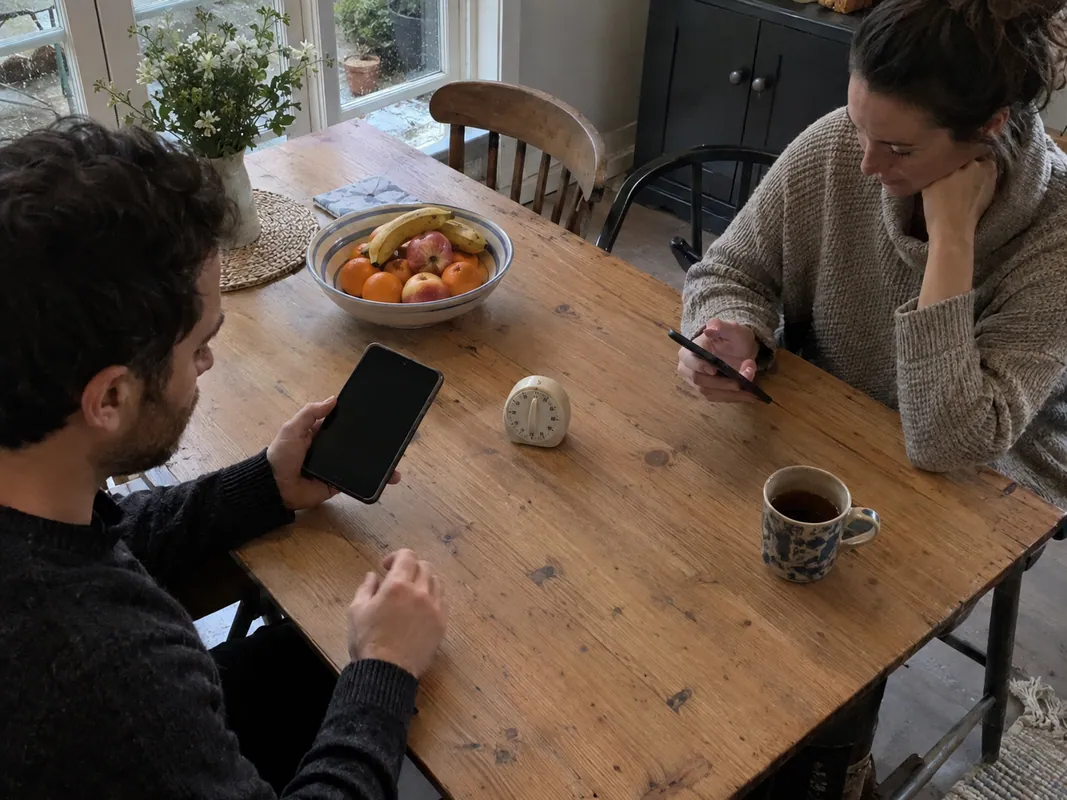
Use one action at a time. Record the starting state on both routes, perform a permitted action from one route, then observe both routes before deciding what happened. Do not label an unseen transition as a defect or a feature. The point is to distinguish a visible result, a documented limitation, and an unresolved observation.
| Step | Proposed observation | What to record | Why it matters |
|---|---|---|---|
| Baseline | Open each confirmed route | Account, firmware identifier if shown, connection state | Prevents comparing different starting conditions |
| Action | Change one agreed setting on one route | Action, actor, time order | Keeps cause separate from assumption |
| Readback | Check the initiating route and the second route | Displayed state and any feedback | Shows whether both people can interpret the result |
| Recovery | Close and reopen one route if documented | State after return | Separates a transient display from a durable product state |
The table is a proposed review tool, not an acceptance test or a claim about network performance. A brand can decide that one setting must be reflected immediately, while another merely needs a clear refresh path. That choice should be written into the brief rather than inferred from a demonstration.
What Should Not Be Mixed into the Same Verdict?
Synchronization is not the same as video latency, general Wi-Fi compatibility, account permissions, or multi-viewer PTZ arbitration. A camera view can arrive while a setting label remains stale; a setting can be shared while only one role is allowed to alter it. Review those questions separately so a single complaint does not become an unsupported diagnosis of the entire architecture.
Ask the supplier to clarify the actual routes in scope: parent unit, app, invited app user, or another confirmed interface. If a route is absent from the selected configuration, mark it out of scope. If a sample cannot demonstrate the intended sequence, reduce the launch claim or keep the requirement open instead of inventing a synchronization rule.
How Should the Result Reach the Product Brief?
Write the requirement in user language. “After the approved alert setting is changed from the parent unit, the app user needs a documented way to identify the current setting” is clearer than “real-time cloud synchronization.” It describes an outcome without claiming a protocol, timing threshold, or service architecture that the buyer has not verified.
The same record should name the owner of each follow-up: product owner for the intended behavior, supplier for configuration confirmation, App/UI owner for visible feedback, and documentation owner for the wording. ANHONG can use that input during a sample and customization discussion, but no generic article can substitute for a model-specific review.
When Is a Smaller Scope the Better Decision?
Sometimes the cleanest decision is to expose fewer cross-device controls. A brand may decide that an app can view a state but only the parent unit can change it, or that a setting is intentionally local. This is not automatically inferior. It can be easier to explain, test, and support when it matches the intended buyer and channel.

Before launch, link the approved state list to packaging copy, setup instructions, and support intake. A support agent should be able to ask which route changed the setting, what each route displayed, and which configuration was used. That produces useful evidence without claiming that a household’s experience proves a universal fault.
For a connected or hybrid concept, begin with ANHONG’s product-development overview and baby monitor customization. Bring the state sequence to a sample, MOQ and lead-time discussion or contact ANHONG with the intended interfaces and market scope.
What Else Should Buyers Ask About Two-Route States?
Should every setting appear on both routes?
No. Decide which setting needs cross-route visibility for the intended user task, then ask whether the selected configuration supports it.
Does a refreshed screen prove a setting was stored?
Not by itself. Record what was visibly read back and ask the supplier which behavior is documented for that configuration.
Can two reviewers use one account?
Only if the confirmed sample setup permits it. Record the account and route arrangement so the observation can be repeated.
Is this a cybersecurity assessment?
No. Access control and cybersecurity evidence require a separate, configuration-specific review.